How sweet your word is to my taste — sweeter than honey in my mouth!
Psalm 119:103
In the 90’s, Dr. Linda Bartoshuk identified that some individuals, deemed “supertasters,” have a heightened sensitivity to certain tastes, including sweetness, which they experience as more intensely pleasurable than “medium tasters” or “non-tasters.” This approximately 25% of the population has more densely packed tastebuds, or more specifically, fungiform papillae, on a certain area of the tongue compared to non-tasters who have virtually none.
While factors like age, health, and certain conditions can influence taste throughout a person’s life, the physiology of a person’s taste is primarily genetic, and even with years of practice decoding nuanced flavors, a non- or medium taster can never become a supertaster.
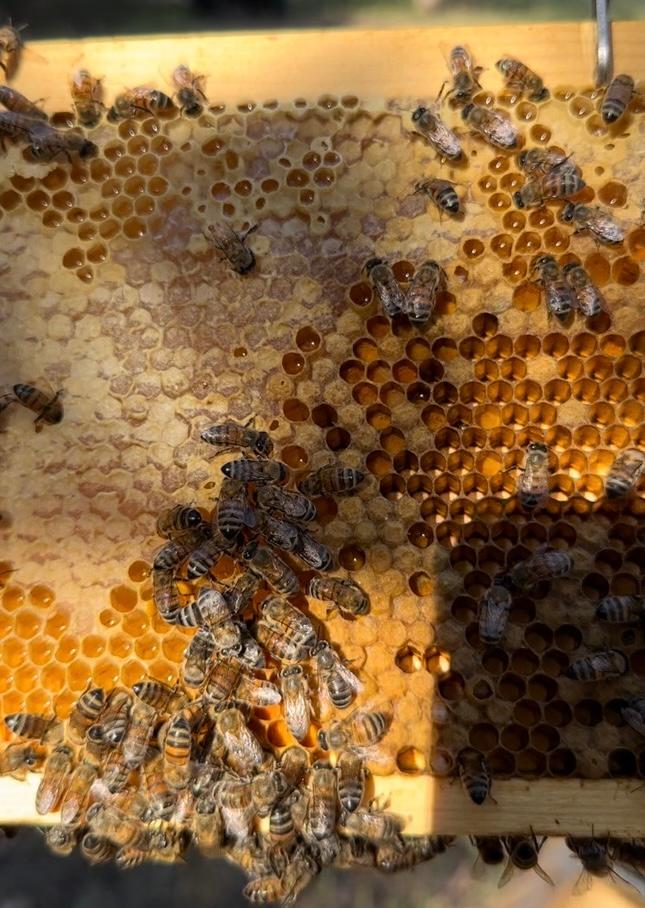
My husband has recently become a recreational beekeeper. He has spent countless hours researching and tending his new little hive, watching eggs laid and baby bees hatch and honey and propolis accumulate. Of the many fascinating aspects of bees, one of his favorites is seeing the bees come home after a day of ranging miles-wide, covered all over in a thick layer of pollen. We don’t have many flowers on our land this time of year, so for now we can only guess at what kind of flora our honey will smack of, or if it will be a plainer taste, a byproduct of the sugar water with which we supplement them. One thing is almost certain: my children won’t know the difference between it and Great Value clover honey when I put it on their peanut butter sandwiches. It will be up to a more refined palate to decide.
We were talking about the idea of palates and appetites in Sunday school last week. To the writer of Psalm 119, God’s Word is sweeter than honey, which is a concept difficult for a modern audience to grasp, both metaphorically and literally. Sure, we are familiar with foods that are chock-full of highly processed sugars and high fructose corn syrups that can be delivered to our fungiform papillae with great ease and intensity of impact. You don’t buy the foods marketed as “sweetened with honey” over the traditionally manufactured variety because you think they will taste sweeter. But were you to take a spoonful of honey alongside a spoonful of sugar, you probably wouldn’t think one tasted any sweeter than the other. But maybe I’m just a medium-taster.
Honey is slow. Not only slow to be made, slow to process, and slow to drip, but it is slow to use and evokes slowness in its consumption. You don’t plop it in your hot tea; you let it fall off the spoon and then you stir it luxuriantly for the next half hour as you taste it sip by sip. You don’t gobble it down like junk food; you add it a bit at a time to recipes or drizzle it on warm buttered bread.
Metaphorically, the words of this psalm convey not only having an appetite for God’s Word like one would crave something sweet, but also the high level of desirability that Scripture holds for the psalmist. This is jarring for readers of today’s world where every pleasure possible is at our fingertips. Our bodies release dopamine just by picking up our phones! More when we click, more when we scroll, more when we post, and more when we get positive feedback. Our pleasure baselines are higher than they used to be, and we wonder why God’s Word does not taste as sweet as it once did.
In class, Billy countered this idea with a concomitant issue at stake: “As much as it is important to re-train ourselves in order to find pleasure in reading the Bible, these verses are also about seeing God’s Word for what it already is, the most pleasurable and satisfying part of our life.” Lately, I have been thinking about this in my research for another project and in my personal life — that despite being bombarded with “answers” to literally every problem in today’s world, we aren’t necessarily meant to find new ways of doing things or panaceas for our manifold ailments, but we simply slow down, turn our eyes from worthless things, and let Christ, the power of God, be what it already is.
Unlike our fungiform papillae, we can change our tastes, and while that is imperative for realignment, we also have to realize that we are all (those who have the Holy Spirit) already spiritual supertasters. Through His Spirit, we are capable of savoring the food that is already on our plates, already ours through Christ. Take and eat.

 Day with Grace
Leave a comment